
Injection Mold Release Coatings
NanoMoldCoating®
NanoMoldCoating or NanoMoldRelease has been scientifically formulated with the use of polymer technology to create a semi-permanent barrier on the surface of molds which facilitates extraordinary plastic or rubber part release. The cured injection mold coating is a non-toxic, and colorless hardened polymer film that is only 100-200 nanometers in thickness so it has no effect on finished part dimensions.

It does not migrate out to the part surface, thereby allowing for secondary painting and decorating processes. This also allows the coating to be used in clean room and paint booth environments where silicone release products are forbidden.
NanoMoldCoating Benefits
- Increases productivity – more parts per hour, per shift, per day
- Flexibility – quickly and easily applied in house
- Cost effective – no need to ship tools to secondary vendors for expensive coatings
- Enhances material flow in molds due to its low coefficient of friction
- Improves part packing capability while allowing parts to release easily
- Allows for reduction in injection pressure and temperatures
- Eliminates streaking and drag marks upon mold filling
- Acts as a corrosion inhibitor
- Eases cleaning of material buildup due to out gassing resins
- Eases color changes
- Eliminates the use of aerosol and other mold release agents
- Does not migrate to the part surface
- Can be used in clean rooms and in secondary painting facilities
- Maintains dimensional integrity of molds
- Can be used for release of all thermoplastic and rubber materials
NanoMoldCoating Cure Times
After a NanoMoldCoating has been applied, it will need to be heat cured. See list below for cure times.
Heat Cure
2-4 hours
Heat Cure HCF
3-4 hours
Quick Cure
15-30 minutes
Quick Cure Rubber Formula
15-30 minutes
Quick Cure Silicone Formula
15-30 minutes
Once cured, resulting polymer film coating exudes anti-stick and anti-corrosion properties with an extremely low-friction coefficient.
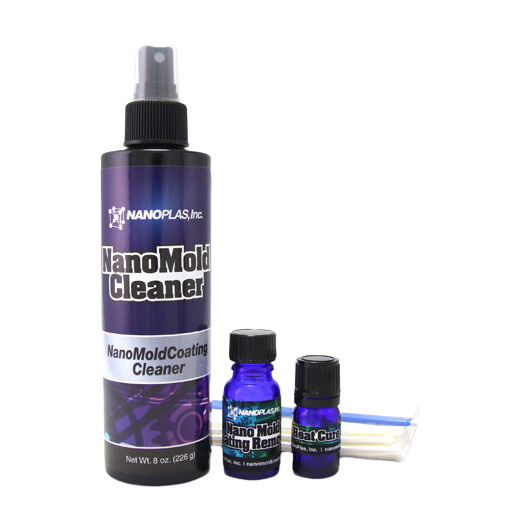
HC Heat Cure
HC Heat Cure is a scientifically formulated injection mold coating that uses polymer technology to create a semi-permanent barrier on the surface of a mold which is only 100 nanometers in thickness and facilitates extraordinary plastic or rubber part release. HC is applied in the tool room and is the longest lasting of our Nano coatings.
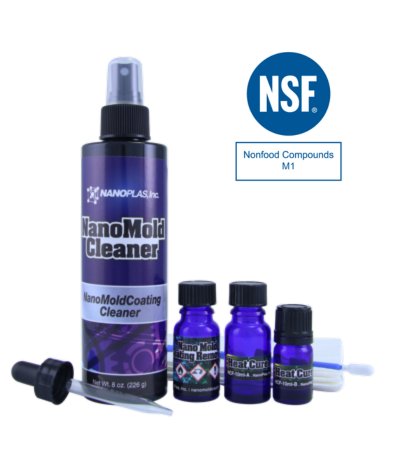
Heat Cure HCF
NSF-Listed M1
Heat Cure HCF is a scientifically formulated, FDA compliant coating that uses polymer technology to create a semi-permanent barrier on the surface of a mold which is only 100 nanometers in thickness and which facilitates extraordinary plastic or rubber part release. Heat Cure HCF is a two-part mixture that is applied in the tool room.
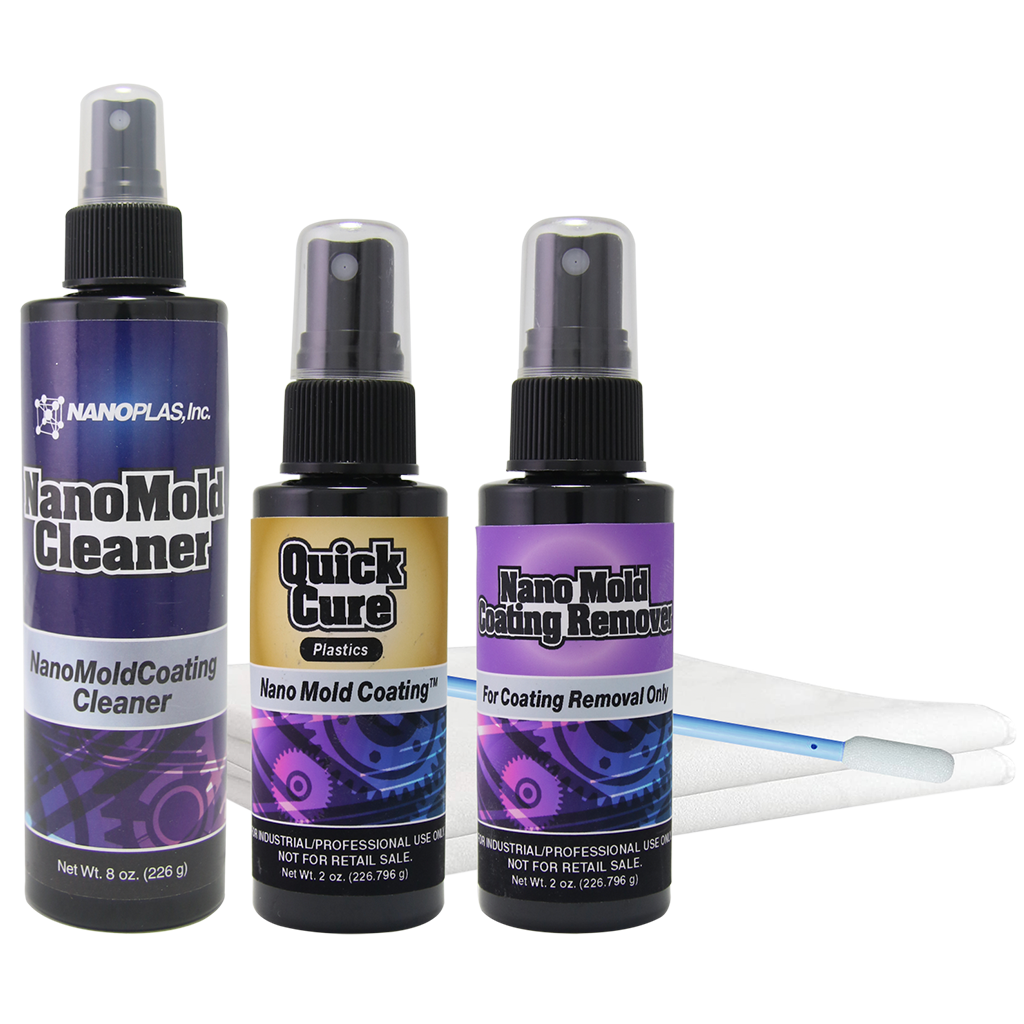
QC Quick Cure
QC Quick Cure has been scientifically formulated with the use of polymer technology to create a semi-permanent barrier on the surface of a mold which is only 100 nanometers in thickness and which facilitates extraordinary plastic part release. QC is applied on the press for those applications that need a quick solution.
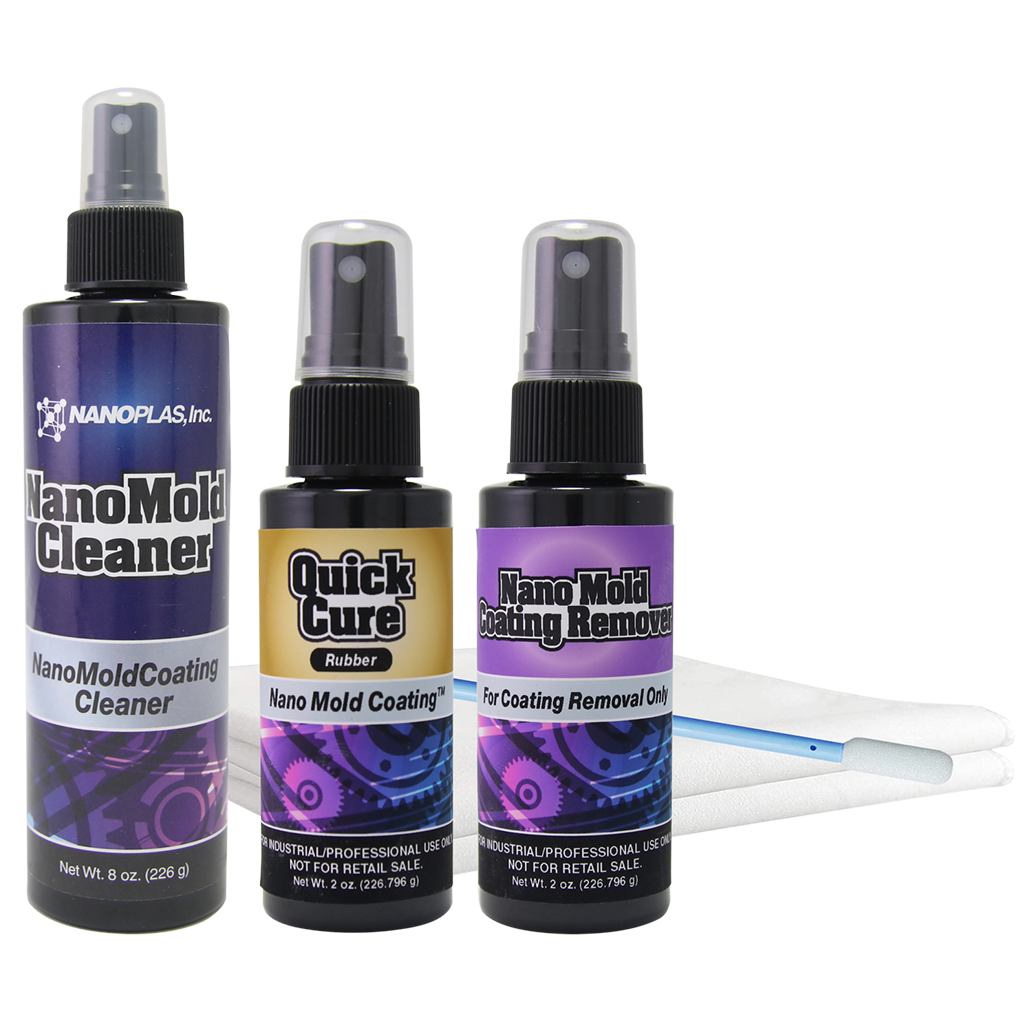
QCRU Quick Cure Rubber Formula
QCRU Quick Cure Rubber Formula has been scientifically formulated with the use of polymer technology to create a semi-permanent barrier on the surface of a mold which is only 100 nanometers in thickness and which facilitates extraordinary rubber part release. QC is applied on the press for those applications that need a quick solution.
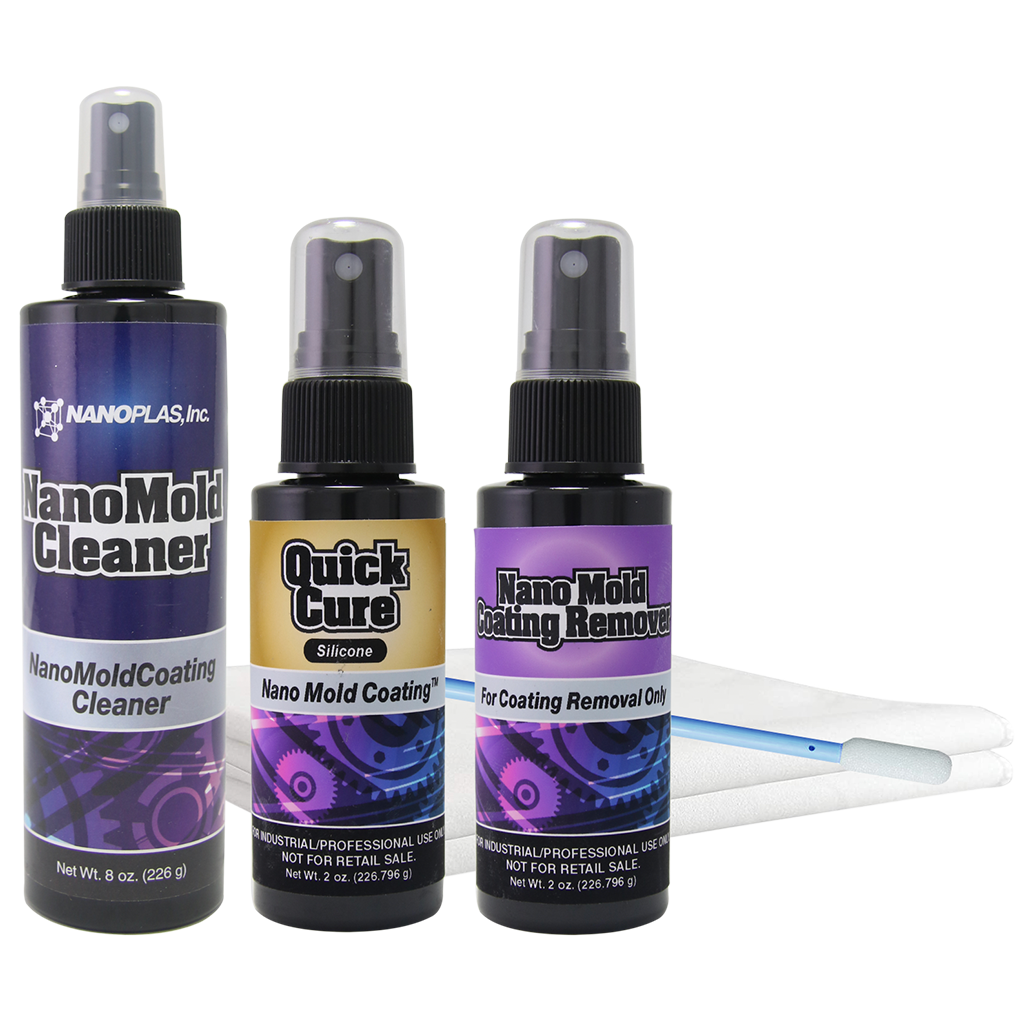
QCSI Quick Cure Silicone Formula
QCSI™ Quick Cure Silicone Formula has been scientifically formulated with the use of polymer technology to create a semi-permanent barrier on the surface of a mold which is only 100 nanometers in thickness and which facilitates extraordinary silicone part release. QC is applied on the press for those applications that need a quick solution.
How to Apply HC and HCF NanoMoldCoating
Watch the video below or visit our in-depth article: How to Properly Apply Injection Mold Coating.
How NanoMoldCoating Works
Nanoplas’ nanotechnology based mold coatings are formulated from several chemical components that self-assemble when applied to a substrate.
These components work together to form a nano-mesh (a microscopic netting) that prohibits molecules from fluids or polymers from coming into contact with surface structures of the substrate. This netting is vapor-permeable, allowing gases to escape from the substrate. Or, allowing the coating to “breathe.”
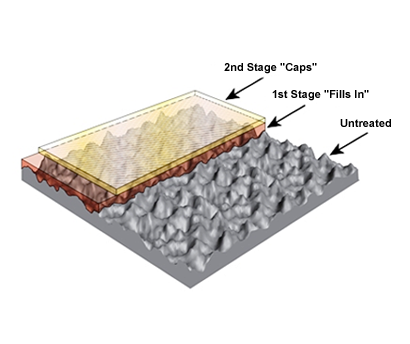
As NanoMoldCoating is applied, it completes two stages. In the first stage, it anchors itself to the substrate by filling in the microscopic hills and valleys in the substrate and attaching to free molecules at the surface.
In the second stage, the coating cross-links while it cures, forming the microscopic nano-mesh structure, which contains hydrophobic and oleophobic properties. This structure can withstand a wide range of temperatures from -40º to 1000°F without compromising the stability of the nano-mesh cross-linking structure or its adherence to the substrate.
Due to its unique molecular structure, NanoMoldCoating has inherent flexibility, allowing it to stretch and contract with the substrate through these ranges in temperature without cracking or peeling. NanoMoldCoating is easily applied in-house by simply wiping it on with a microfiber cloth or brushing it into tighter areas.
Performance Outcomes for Mold Release Coatings
- Higher Throughput: Semi-permanent coatings reduce cycle interruptions, enabling more parts per shift.
- Reduced Maintenance: Anti-stick and anti-corrosion properties minimize buildup, lowering cleaning frequency.
- Improved Surface Quality: Eliminates streaks, drag marks, and residue transfer for consistent part finishes.
- Energy Efficiency: Lower injection pressures and temperatures reduce energy consumption during molding.
How To Choose the Right Coating Formula
- HC Heat Cure: Longest-lasting option, ideal for tool room applications requiring durability.
- HCF Heat Cure: FDA-compliant, NSF-listed formula for medical and food-grade environments.
- QC Quick Cure: Fast application on the press for plastic molds needing immediate release solutions.
- QCRU Quick Cure Rubber Formula: Tailored for rubber molding operations requiring rapid turnaround.
- QCSI Quick Cure Silicone Formula: Specialized for silicone resins where clean release is critical.
Compatibility and Application Best Practices
- Material Types: Works with all thermoplastics, rubber, and silicone without affecting part dimensions.
- Surface Prep: Ensure molds are clean and dry before application for maximum adhesion.
- Application Method: Wipe or brush evenly; avoid pooling in tight areas.
- Curing Process: Follow recommended cure times to achieve full polymer cross-linking and durability.
Troubleshooting Common Mold Release Issues
- Parts Sticking to Mold: Verify coating cure time and reapply if necessary.
- Uneven Release: Ensure even application and proper substrate preparation.
- Residue On Part Surface: Switch from aerosol agents to NanoMoldCoating to eliminate migration.
- Coating Wear: For high-volume runs, use HC Heat Cure for maximum longevity.
FAQ
What Makes NanoMoldCoating Different from Aerosol Release Agents?
It forms a semi-permanent barrier that doesn’t migrate to the part surface, eliminating contamination risks.
Can NanoMoldCoating Be Used in Clean Rooms?
Yes. Its non-toxic, colorless formulation is suitable for clean rooms.
Does The Coating Affect Part Dimensions?
No. At only 100–200 nanometers thick, it maintains dimensional integrity of molded parts.
Which Formula Should I Use for Fast Turnaround Applications?
Quick Cure formulas (QC, QCRU, QCSI) are designed for in-press application with cure times of 15–30 minutes.